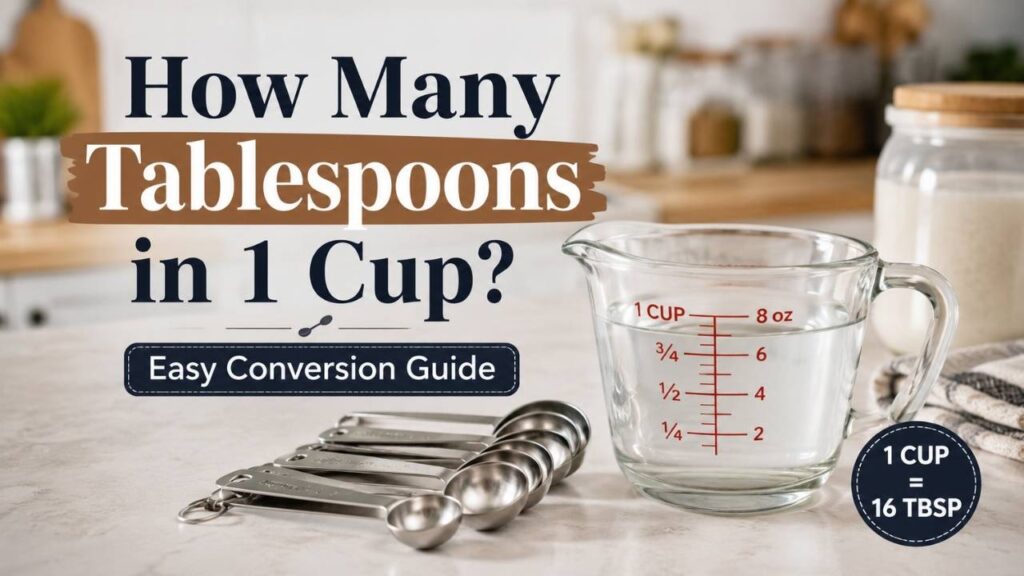

Whether you’re baking cookies, preparing a cake, or following a new dinner recipe, understanding how many tablespoons are in a cup can save time and prevent mistakes in the kitchen. Many recipes use different units of measurement, and converting between them quickly helps ensure your ingredients stay balanced.
The standard answer is simple: 1 cup equals 16 tablespoons. However, knowing more than the basic conversion can make cooking much easier. For example, you may need to know how many tablespoons in half a cup, how many tablespoons in a quarter cup, or how to convert larger measurements when doubling a recipe.
In this guide, you’ll find an easy cup to tablespoon conversion chart, practical examples, and helpful kitchen measurement tips. You’ll also learn the difference between US cup measurements, metric cups, and other common kitchen conversions so you can measure ingredients accurately every time.
Quick Answer
There are 16 tablespoons in 1 US cup. This simple cup to tablespoon conversion is one of the most common measurements used in cooking and baking. If you ever wonder how many tablespoons in 1 cup, the answer is always 16 tablespoons when using standard US measuring cups.
To convert cups to tablespoons, simply multiply the number of cups by 16. For example, 2 cups equal 32 tablespoons, while 1/2 cup equals 8 tablespoons. Knowing this basic cooking measurement conversion can help you follow recipes accurately and adjust ingredient amounts with confidence.
How Many Tablespoons Are in 1 Cup?
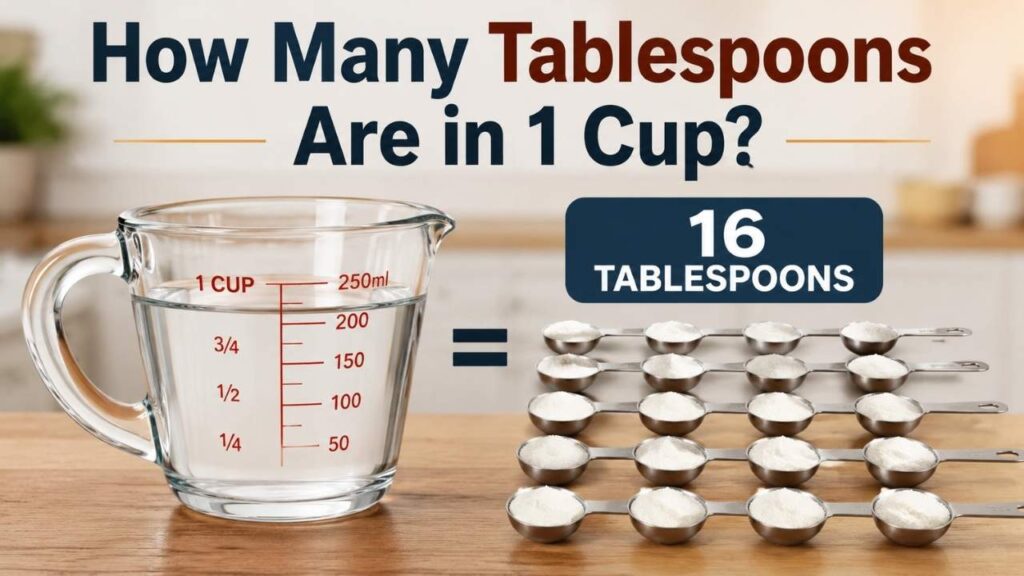
The answer to how many tablespoons in 1 cup is straightforward: 1 US cup equals 16 tablespoons. This is one of the most important cooking measurements and baking measurements to remember because many recipes rely on accurate ingredient amounts. Whether you’re making sauces, cakes, cookies, or homemade bread, understanding this cup to tablespoon conversion helps you follow recipes with confidence.
Many home cooks ask, “1 cup equals how many tablespoons?” The answer remains the same every time when using standard US measuring tools. Simply remember the number 16. If a recipe calls for 1 cup of milk, water, sugar, or flour, you can measure it using 16 level tablespoons if you don’t have a measuring cup available.
The Simple Conversion Formula
Converting cups to tablespoons is easy. Multiply the number of cups by 16.
Formula:
Tablespoons = Cups × 16
Examples:
- 1 Cup = 16 Tablespoons
- 2 Cups = 32 Tablespoons
- ½ Cup = 8 Tablespoons
- ¼ Cup = 4 Tablespoons
This formula works for most standard recipe measurements and helps simplify many kitchen conversions.
Why 1 Cup Equals 16 Tablespoons
The US customary measurement system defines a cup as a specific volume. Within that system, a cup contains 16 tablespoons, making the conversion consistent across cooking and baking recipes.
This relationship allows cooks to scale recipes, substitute measuring tools, and create accurate portions without guesswork. Since many recipes use cups, tablespoons, teaspoons, and fluid ounces together, understanding these measurement relationships can make cooking much easier and more precise.
Cup to Tablespoon Conversion Chart
The following cup-to-tablespoon conversion chart provides quick reference values for common kitchen measurements.
| Cups | Tablespoons |
| 1/8 Cup | 2 Tbsp |
| 1/4 Cup | 4 Tbsp |
| 1/3 Cup | 5 Tbsp + 1 Tsp |
| 1/2 Cup | 8 Tbsp |
| 2/3 Cup | 10 Tbsp + 2 Tsp |
| 3/4 Cup | 12 Tbsp |
| 1 Cup | 16 Tbsp |
| 1 1/2 Cups | 24 Tbsp |
| 2 Cups | 32 Tbsp |
| 3 Cups | 48 Tbsp |
| 4 Cups | 64 Tbsp |
Many people save this type of kitchen conversion chart because it helps when adjusting recipes, doubling servings, or measuring ingredients without a full set of measuring cups.
Common Cup Measurements Converted to Tablespoons
When cooking or baking, you often need more than just the conversion for one cup. Knowing the most common fractional measurements can save time and prevent errors.
How Many Tablespoons in 1/4 Cup?
There are 4 tablespoons in 1/4 cup. This measurement appears frequently in baking recipes, dressings, sauces, and marinades.
How Many Tablespoons in 1/3 Cup?
There are 5 tablespoons plus 1 teaspoon in 1/3 cup. Since tablespoons alone cannot perfectly represent one-third of a cup, adding a teaspoon creates a more accurate measurement.
How Many Tablespoons in 1/2 Cup?
There are 8 tablespoons in half a cup. This is one of the most searched cooking conversion questions because many recipes use half-cup measurements.
How Many Tablespoons in 2/3 Cup?
There are 10 tablespoons plus 2 teaspoons in 2/3 cup. This conversion often appears in baking and dessert recipes.
How Many Tablespoons in 3/4 Cup?
There are 12 tablespoons in 3/4 cup. This measurement commonly appears in cakes, muffins, and cookie recipes.
How Many Tablespoons in 2 Cups?
There are 32 tablespoons in 2 cups. Simply multiply 2 by 16 to get the answer.
How to Convert Cups to Tablespoons
Learning to convert cups to tablespoons helps you work with recipes more efficiently. You don’t need a calculator for most conversions. Just remember that every cup contains 16 tablespoons.
For example:
- 3 Cups = 48 Tablespoons
- 1.5 Cups = 24 Tablespoons
- 2.5 Cups = 40 Tablespoons
This simple conversion method works for many ingredients, including water, milk, sugar, flour, oil, and butter. It is especially useful when you need to adjust recipe sizes or substitute measuring equipment.
Using a reliable conversion formula also helps maintain consistency, which is important for successful baking and cooking.
Tablespoons to Cups Conversion Chart
Sometimes you need to work in the opposite direction and convert tablespoons to cups.
| Tablespoons | Cups |
| 2 Tbsp | 1/8 Cup |
| 4 Tbsp | 1/4 Cup |
| 8 Tbsp | 1/2 Cup |
| 12 Tbsp | 3/4 Cup |
| 16 Tbsp | 1 Cup |
| 24 Tbsp | 1 1/2 Cups |
| 32 Tbsp | 2 Cups |
This chart makes it easy to determine how much a measurement equals when a recipe uses tablespoons instead of cups.
Cups, Tablespoons, Teaspoons, and Fluid Ounces Comparison Table
Different recipes use different units. Understanding how these measurements relate to one another can simplify cooking.
| Measurement | Equivalent |
| 1 Cup | 16 Tbsp |
| 1 Cup | 48 Tsp |
| 1 Cup | 8 Fluid Ounces |
| 1 Tbsp | 3 Tsp |
| 2 Tbsp | 1 Fluid Ounce |
| 16 Tbsp | 1 Cup |
This comparison table serves as a quick measurement cheat sheet for everyday cooking and baking tasks.
US Cup vs Metric Cup vs Imperial Cup
Not all cups have the same volume worldwide. Different countries use different measurement standards.
US Cup Measurement
A standard US cup equals 236.6 milliliters and contains 16 tablespoons.
Metric Cup Measurement
A metric cup equals 250 milliliters and is common in countries such as Australia and New Zealand.
Imperial Cup Measurement
The traditional Imperial system uses slightly different volume standards, although it is less common today.
When following international recipes, always check which cup system the recipe uses to ensure accurate measurements.
Dry vs Liquid Measurements: Does the Conversion Change?
Many people wonder whether dry ingredients and liquid ingredients use different cup-to-tablespoon conversions.
The answer is no. A cup still equals 16 tablespoons regardless of whether you measure flour, sugar, milk, oil, or water.
However, the weight of ingredients changes. One cup of flour weighs much less than one cup of honey, even though both occupy the same volume.
This distinction explains why bakers often use kitchen scales for maximum accuracy. Understanding the difference between volume measurements and weight measurements can improve your baking results significantly.
When Do You Need This Conversion?
Knowing how many tablespoons are in a cup becomes useful in many situations.
Baking Recipes
Precise measurements help cakes, breads, and cookies turn out correctly.
Cooking Recipes
Soups, sauces, marinades, and dressings often require quick conversions.
Scaling Recipes Up or Down
You may need to double or halve recipes. Knowing the conversion formula allows you to adjust ingredients easily without affecting flavor or texture.
These practical uses make cup-to-tablespoon conversions an essential kitchen skill.
Kitchen Measurement Cheat Sheet
Keep these common conversions handy:
- 1 Cup = 16 Tablespoons
- 1 Cup = 48 Teaspoons
- 1 Cup = 8 Fluid Ounces
- 1/2 Cup = 8 Tablespoons
- 1/4 Cup = 4 Tablespoons
- 1 Tablespoon = 3 Teaspoons
- 2 Tablespoons = 1 Fluid Ounce
This quick-reference guide can save time while cooking and baking.
Common Cup-to-Tablespoon Conversion Mistakes
Even simple conversions can lead to mistakes.
Common errors include:
- Confusing teaspoons with tablespoons.
- Using rounded instead of level tablespoons.
- Mixing metric and US measurements.
- Estimating measurements instead of using proper tools.
- Forgetting to adjust ingredient quantities when scaling recipes.
Avoiding these mistakes helps ensure more consistent results in the kitchen.
FAQs
Is 16 Tablespoons Equal to 1 Cup?
Yes. In the US measurement system, 16 tablespoons equal 1 cup.
How Many Tablespoons Are in Half a Cup?
There are 8 tablespoons in half a cup.
How Many Tablespoons Are in a Quarter Cup?
There are 4 tablespoons in 1/4 cup.
Can I Measure a Cup Using Tablespoons?
Yes. Simply use 16 level tablespoons to equal one cup.
How Many Teaspoons Are in One Cup?
There are 48 teaspoons in one cup because each tablespoon contains three teaspoons.
Conclusion
Understanding how many tablespoons in 1 cup is a simple but valuable kitchen skill. The standard conversion is easy to remember: 1 cup equals 16 tablespoons. Once you learn this basic relationship, you can confidently convert measurements, adjust recipes, and measure ingredients accurately.
Whether you’re baking cookies, preparing dinner, or scaling a recipe for a larger group, knowing these cooking measurement conversions helps you achieve consistent results every time. Save the conversion charts above as a handy reference and you’ll always have the right measurements at your fingertips.