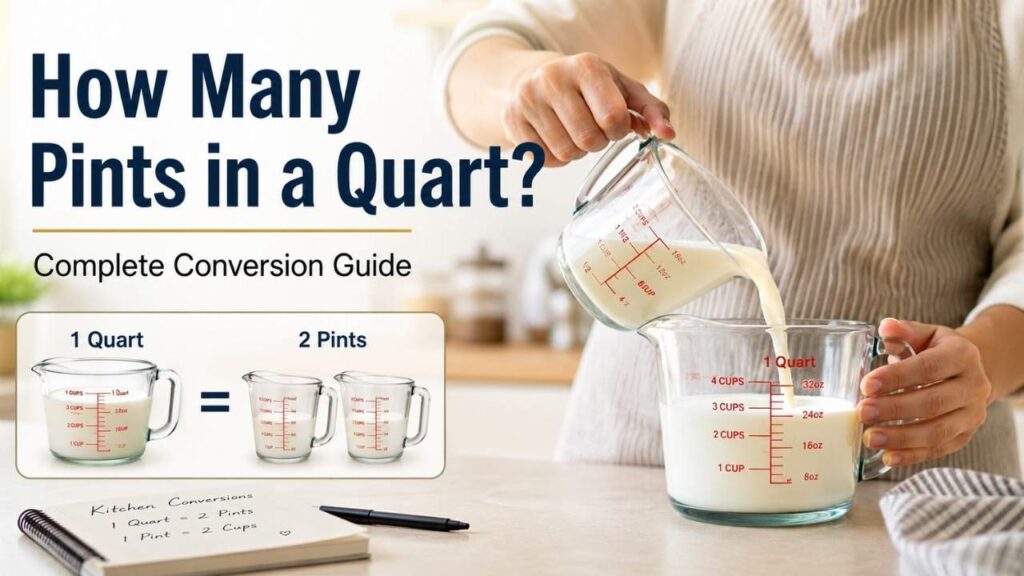

How many pints in a quart? The answer is simple: 1 quart equals 2 pints. This basic quart-to-pint conversion helps you measure liquids accurately when cooking, baking, meal prepping, or following recipes. Whether you need to know how many pints are in a quart, convert large quantities, or understand common liquid measurements, learning this conversion can save time in the kitchen.
Many people use pints and quarts every day but often forget how these units relate to each other. Fortunately, the conversion is easy because every quart contains exactly 2 pints. Once you understand this relationship, you can quickly convert quarts to pints, scale recipes, and work with other volume measurements such as cups, gallons, and fluid ounces.
In this guide, you’ll learn the quart to pint conversion formula, explore useful conversion charts, compare pint vs quart measurements, and discover practical kitchen examples that make these units easier to understand.
Quick Answer
There are 2 pints in 1 quart. If you need a quick quart-to-pint conversion, simply multiply the number of quarts by 2. For example, 2 quarts equal 4 pints, while 3 quarts equal 6 pints. This simple rule makes it easy to convert quarts to pints for cooking, baking, and other liquid measurements. Knowing how many pints are in a quart helps you measure ingredients accurately and follow recipes with confidence.
Quart-to-Pint Formula
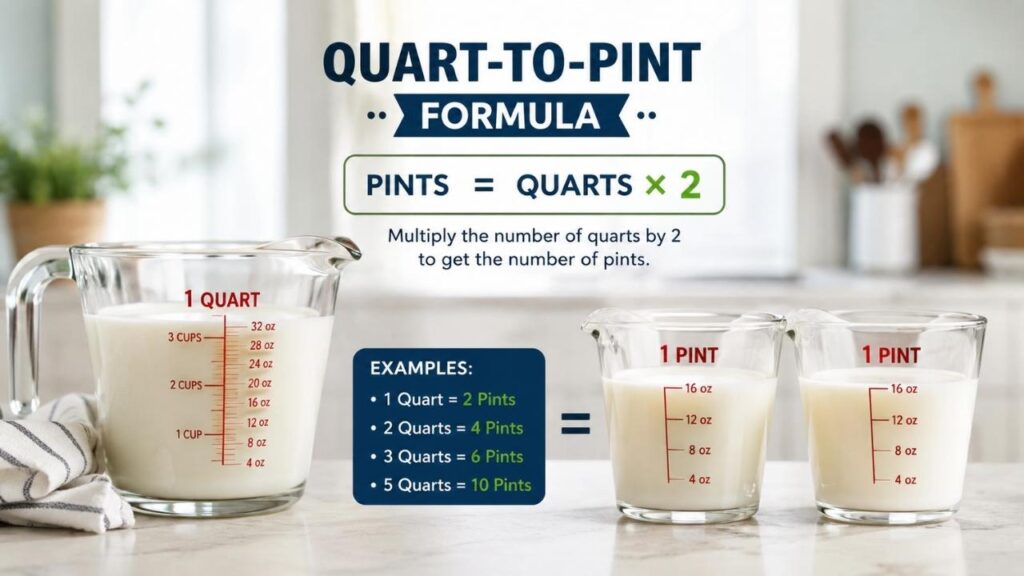
Understanding the quart-to-pint conversion formula makes it easy to convert measurements without looking at a chart. The rule is simple: multiply the number of quarts by 2 to find the equivalent number of pints. Since 1 quart equals 2 pints, every additional quart adds two more pints to the total.
For example, 2 quarts equal 4 pints, 3 quarts equal 6 pints, and 5 quarts equal 10 pints. This formula works for common liquid measurements used in cooking, baking, and food preparation.
Learning how to convert quarts to pints can help you adjust recipes and measure ingredients accurately. Whether you are preparing a family meal or scaling a recipe for a larger gathering, this quick volume conversion saves time and reduces mistakes in the kitchen.
Simple Conversion Examples
Many people understand a conversion better when they see real examples. If you’re wondering how many pints are in a quart, remember that every quart contains two pints. Therefore, 1 quart equals 2 pints, 2 quarts equal 4 pints, and 4 quarts equal 8 pints. If a recipe calls for 3 quarts of broth, you can quickly convert that amount to 6 pints.
Likewise, half a quart equals 1 pint because it represents half of the standard quart-to-pint relationship. These examples make quarts-to-pints conversions easy to remember and apply in everyday situations. Whether you are measuring soup, milk, juice, or another liquid, using simple examples helps build confidence.
Once you practice a few calculations, converting pints and quarts becomes second nature and much easier to perform without a calculator.
How to Convert Quarts to Pints
Knowing how to convert quarts to pints is useful whenever you work with recipes, food storage containers, or measurement charts. The process is straightforward because the relationship between these units never changes.
Start with the number of quarts you have and multiply that value by 2. The result gives you the number of pints. For example, if you have 7 quarts of liquid, multiply 7 by 2 to get 14 pints. This quick measurement conversion works for all standard volume measurements. Many home cooks use this method when doubling recipes or converting ingredient quantities.
Since 1 quart equals 2 pints, the calculation remains consistent and easy to remember. Understanding this basic conversion improves kitchen accuracy and helps ensure recipes turn out exactly as intended every time.
Mental Math Trick for Fast Conversion
You don’t always need a calculator to perform a quart-to-pint conversion. A simple mental math trick can help you find the answer instantly. Instead of thinking about formulas, just remember that every quart contains two pints.
Then double the number of quarts in your head. For example, if someone asks how many pints are in 4 quarts, simply double 4 to get 8. If you have 6 quarts, double 6 to get 12 pints. This shortcut works because the conversion ratio never changes. It is especially helpful while cooking, shopping, or checking ingredient amounts.
Many professional cooks use quick mental calculations to save time in the kitchen. Once you memorize that 1 quart equals 2 pints, most common liquid measurement conversions can be completed in just a few seconds.
How to Convert Pints to Quarts
Sometimes you need to perform the reverse conversion and change pints into quarts. Fortunately, the process is just as simple. Because 2 pints equal 1 quart, you divide the number of pints by 2 to find the number of quarts.
For example, 8 pints divided by 2 equals 4 quarts, while 10 pints divided by 2 equals 5 quarts. This reverse volume conversion is useful when recipes list ingredients in pints but your measuring tools use quarts. Understanding both directions of the conversion gives you more flexibility in the kitchen.
Whether you are measuring liquids for cooking, baking, or food preparation, knowing how to switch between pints and quarts helps ensure accuracy. This simple conversion method works every time and is easy to remember.
Pint vs Quart: What’s the Difference?
Many people use the terms pint and quart interchangeably, but they represent different units of volume measurement. A pint is smaller than a quart, and understanding the difference can help you follow recipes more accurately. The easiest way to remember the relationship is that 1 quart equals 2 pints.
If you have a quart-sized container, it can hold the same amount as two pint-sized containers. Both units belong to the US customary measurement system and commonly appear in cooking, baking, and food storage. While a pint is useful for smaller quantities of liquids, a quart works better for larger amounts.
Knowing the difference between these units makes quart-to-pint conversions easier and helps prevent mistakes when measuring ingredients for recipes or preparing large batches of food.
Size Comparison
A simple size comparison can help you understand the relationship between pints and quarts. Since 1 quart equals 2 pints, a quart always holds twice as much liquid as a pint. Imagine filling two pint containers with water and pouring them into a larger container. The larger container would hold exactly one quart.
This relationship stays the same whether you measure milk, juice, broth, or another liquid. Understanding this comparison makes it easier to estimate quantities without relying on a conversion chart. Many cooks use this knowledge when scaling recipes or choosing the right container for storage.
Once you remember that a quart is double the size of a pint, you can perform quick volume conversions and confidently work with common liquid measurements in everyday cooking and baking situations.
Visual Measurement Breakdown
Learning how cups, pints, quarts, and gallons connect can make kitchen measurements much easier. In the US customary system, 1 pint equals 2 cups, 1 quart equals 2 pints, and 1 gallon equals 4 quarts. This means a gallon contains 8 pints and 16 cups.
Many people find it easier to remember measurements when they understand the complete hierarchy rather than memorizing individual conversions. Visualizing these units as building blocks can help. Two cups create one pint, two pints create one quart, and four quarts create one gallon.
This simple structure makes measurement conversion more logical and easier to remember. Whether you are preparing meals, baking desserts, or storing leftovers, understanding these relationships can save time and help ensure accurate ingredient measurements every time.
Where Quarts and Pints Are Used in Everyday Life
Although many people learn about pints and quarts in school, these units remain useful in daily life. They frequently appear in recipes, grocery stores, food packaging, and beverage containers. Understanding how many pints are in a quart helps when purchasing liquids, comparing product sizes, or preparing meals.
For example, milk, soup, stock, and ice cream often come in pint or quart containers. Home cooks also rely on these units when adjusting recipes or storing leftovers. Even when using measuring cups, knowing the relationship between pints and quarts can make ingredient calculations easier.
Because these units are common throughout the United States, understanding their relationship improves accuracy and reduces confusion. Learning basic volume conversions allows you to make better decisions when cooking, shopping, and managing household food supplies.
Cooking
Cooking often requires accurate liquid measurements, making it important to understand the relationship between quarts and pints. Many soup, stew, and sauce recipes use these units because they provide a convenient way to measure larger amounts of liquid.
If a recipe calls for 2 quarts of broth, you can quickly convert that amount to 4 pints. This knowledge becomes especially helpful when your measuring containers use different units than the recipe. Professional chefs and home cooks regularly perform quart-to-pint conversions to adjust serving sizes and scale recipes.
Understanding these measurements also helps prevent mistakes that can affect the flavor or consistency of a dish. By learning how to convert quarts to pints, you can confidently prepare recipes and ensure your ingredients remain properly balanced throughout the cooking process.
Baking
Baking relies heavily on precision, which makes understanding measurement conversions especially important. While baking recipes often use cups, larger recipes may also reference pints and quarts. Knowing that 1 quart equals 2 pints helps you measure liquids accurately and avoid errors that could affect the final result.
Whether you’re preparing cake batter, bread dough, or dessert fillings, proper measurements contribute to consistent outcomes. Bakers frequently scale recipes up or down, making quart-to-pint conversion skills valuable. When increasing recipe quantities, understanding volume relationships helps maintain the correct ingredient ratios.
Accurate liquid measurements also improve texture and consistency. Because baking requires more precision than many cooking methods, understanding how pints and quarts relate to one another can help you achieve reliable, professional-quality results every time you bake.
Food Storage
Understanding pints and quarts can also help with food storage and meal preparation. Many storage containers list their capacity in these units, making it easier to estimate how much food they can hold. For example, a container labeled as 1 quart can hold the same volume as 2 pints.
This knowledge helps when storing soups, sauces, leftovers, and meal-prep ingredients. Knowing container sizes can also prevent overfilling and reduce food waste. Many families use quart-sized containers for larger portions and pint-sized containers for individual servings.
By understanding basic volume measurements, you can choose the right container for your needs and organize food more efficiently. This simple knowledge makes kitchen management easier and helps ensure ingredients remain fresh and properly stored until they are ready to use.
Grocery Shopping
Knowledge of quart and pint conversions can be surprisingly useful while grocery shopping. Many products, including milk, cream, ice cream, and beverages, are sold in containers labeled in pints or quarts. Understanding these units helps you compare sizes and determine which package offers the best value.
Since 1 quart equals 2 pints, you can quickly compare products even when they use different measurements. This skill becomes especially useful when planning meals or purchasing ingredients for large gatherings. It also helps you estimate how much product you need without buying too little or too much.
Understanding common liquid measurements allows you to make informed purchasing decisions and avoid confusion when comparing brands. A basic understanding of volume conversion can save both time and money during routine shopping trips.
Understanding the Liquid Measurement System
The liquid measurement system provides a standard way to measure and compare volumes. In the United States, the most common units include cups, pints, quarts, and gallons.
Each unit relates directly to the next, making conversions straightforward once you understand the pattern. For example, 1 pint equals 2 cups, 1 quart equals 2 pints, and 1 gallon equals 4 quarts. These relationships help cooks, bakers, and food manufacturers measure liquids accurately.
Understanding this system makes volume conversion easier and reduces the need to memorize dozens of separate formulas. It also improves confidence when following recipes or purchasing ingredients. By learning how these units connect, you can quickly perform common kitchen calculations and better understand the measurement information found in recipes and food packaging.
Cups, Pints, Quarts, and Gallons Relationship
The relationship between cups, pints, quarts, and gallons follows a simple pattern that makes conversions easy to remember. Two cups equal one pint, two pints equal one quart, and four quarts equal one gallon. This means a gallon contains sixteen cups, eight pints, or four quarts.
Understanding these connections helps simplify kitchen calculations and reduces measurement mistakes. Many recipes require switching between units, so knowing how they relate can save time and improve accuracy. Whether you need to convert cups to pints or determine how many pints are in a gallon, these relationships provide a reliable foundation.
Learning this measurement hierarchy allows you to perform quick liquid measurement conversions and better understand the quantities used in cooking, baking, food preparation, and everyday household tasks.
Easy Measurement Hierarchy Chart
A simple hierarchy makes it easier to remember common volume measurements:
- 1 Pint = 2 Cups
- 1 Quart = 2 Pints
- 1 Quart = 4 Cups
- 1 Gallon = 4 Quarts
- 1 Gallon = 8 Pints
- 1 Gallon = 16 Cups
This structure shows how each unit connects to the next larger unit. Many people find this hierarchy easier to remember than separate conversion formulas. By understanding the complete measurement system, you can quickly convert between cups, pints, quarts, and gallons.
This knowledge proves useful in cooking, baking, grocery shopping, and food storage. Keeping this chart handy can simplify recipe preparation and reduce mistakes. Once you become familiar with these relationships, most common measurement conversions can be completed mentally in just a few seconds.
US Quart vs Imperial Quart
Although both systems use the terms quart and pint, the US customary system and the Imperial system measure slightly different volumes. A US quart and an Imperial quart are not exactly the same size. Likewise, a US pint and an Imperial pint differ in volume. However, the relationship between the units remains consistent within each system.
In both cases, 1 quart equals 2 pints. This means the conversion rule never changes, even though the actual volume may vary slightly. Most recipes in the United States use US customary measurements, while some international recipes may use Imperial units.
Understanding this distinction can help avoid confusion when following recipes from different countries and ensure accurate measurements during cooking and baking.
What Is a US Quart?
A US quart is a standard unit of liquid capacity used throughout the United States. It equals two pints, four cups, or thirty-two fluid ounces. Many common products, including milk, broth, and juice, are sold in quart-sized containers.
Because the quart is larger than a pint, it provides a convenient measurement for larger quantities of liquid. Home cooks frequently encounter this unit in recipes, storage containers, and grocery packaging. Understanding the size of a US quart helps simplify quart-to-pint conversions and improves measurement accuracy.
Since it plays an important role in cooking and baking, becoming familiar with this unit can make recipe preparation easier and more efficient. Knowing how it relates to cups, pints, and gallons also strengthens your understanding of the overall measurement system.
What Is an Imperial Quart?
An Imperial quart belongs to the measurement system traditionally used in the United Kingdom and some other countries. While it differs slightly in volume from a US quart, its relationship with the pint remains the same.
An Imperial quart still equals two Imperial pints. This consistency makes the quart-to-pint conversion straightforward regardless of which system you use. However, because the actual size of an Imperial quart is larger than a US quart, recipes may produce slightly different results if measurements are mixed.
When following international recipes, it is helpful to verify which measurement system the recipe uses. Understanding the difference between US and Imperial units helps ensure accurate results and prevents confusion when working with recipes, conversion charts, and cooking measurements from different regions.
Why the Conversion Still Equals 2 Pints
Many people wonder why the conversion remains the same even though US and Imperial measurements differ. The reason is simple: both systems define a quart as containing two pints. While the actual volume of each unit varies slightly between systems, the ratio between them stays unchanged.
As a result, 1 quart always equals 2 pints whether you use US customary measurements or Imperial measurements. This consistency makes the conversion easy to remember and apply. You don’t need separate formulas for each system because the relationship remains identical.
Understanding this concept helps reduce confusion and makes volume conversion more straightforward. Whether you’re following a recipe, measuring ingredients, or comparing container sizes, you can confidently rely on the same basic conversion rule.
Common Conversion Mistakes
Even simple measurement conversions can lead to mistakes if you’re not careful. One common error involves confusing cups, pints, and quarts. Some people mistakenly assume that one quart equals one pint, but 1 quart actually equals 2 pints.
Another frequent mistake occurs when people mix US customary units with Imperial units without adjusting for volume differences. Using the wrong measurement system can affect recipe results. Some cooks also misread conversion charts or forget to convert ingredient amounts when doubling recipes.
To avoid these problems, always double-check measurements and use a reliable conversion reference when needed. Understanding the relationship between cups, pints, quarts, and gallons helps minimize errors and improves accuracy. With a little practice, most common conversion mistakes become easy to avoid.
FAQs
Is 2 Pints Equal to 1 Quart?
Yes. 2 pints equal 1 quart, making this one of the most common kitchen conversions.
Is a Quart Bigger Than a Pint?
Yes. A quart is twice the size of a pint because 1 quart contains 2 pints.
How Many Pints Are in 2 Quarts?
There are 4 pints in 2 quarts because each quart contains two pints.
How Many Pints Are in Half a Quart?
Half a quart equals 1 pint, making it an easy conversion to remember.
Why Are Pints and Quarts Used in Recipes?
Recipes use pints and quarts because they provide convenient ways to measure larger quantities of liquids accurately.
How Many Pints Are in a Gallon?
There are 8 pints in 1 gallon because a gallon contains four quarts and each quart contains two pints.
Conclusion
Understanding how many pints are in a quart is a simple but useful skill that can make cooking, baking, and everyday measurement conversions much easier. Remember, 1 quart equals 2 pints, so you can quickly convert quarts to pints by multiplying the number of quarts by two.
Whether you’re following a recipe, storing food, or comparing product sizes while shopping, knowing this basic quart-to-pint conversion can save time and improve accuracy. It also helps to understand how pints, quarts, cups, and gallons fit together within the liquid measurement system.
By learning these relationships and using the conversion charts and examples in this guide, you can confidently work with common volume measurements and avoid mistakes whenever you need to measure or convert liquids.