
If you’ve ever followed a recipe and wondered how many grams in a teaspoon, you’re not alone. Many cooks and bakers need a reliable teaspoon to grams conversion when measuring ingredients. However, there is no single answer because a teaspoon measures volume, while grams measure weight. Different ingredients have different densities, which means the number of grams in a teaspoon changes from one ingredient to another.
For example, a teaspoon of sugar weighs differently from a teaspoon of flour, salt, or honey. Understanding this difference helps you achieve better results when cooking or baking. Accurate measurements improve consistency and reduce mistakes.
In this guide, you’ll learn how many grams are in a teaspoon, how to convert teaspoons to grams, and why ingredient density matters. You’ll also find conversion charts, formulas, and practical examples to make kitchen measurements easier.
Quick Answer
There is no universal answer to how many grams are in a teaspoon because the conversion depends on the ingredient. As a general guide, 1 teaspoon of water equals 5 grams, sugar equals about 4.2 grams, flour equals around 2.5 grams, salt weighs 5–6 grams, and honey weighs about 7 grams. Always use an ingredient-specific teaspoon conversion chart for accurate cooking and baking measurements.
Why a Teaspoon Does Not Always Equal the Same Number of Grams
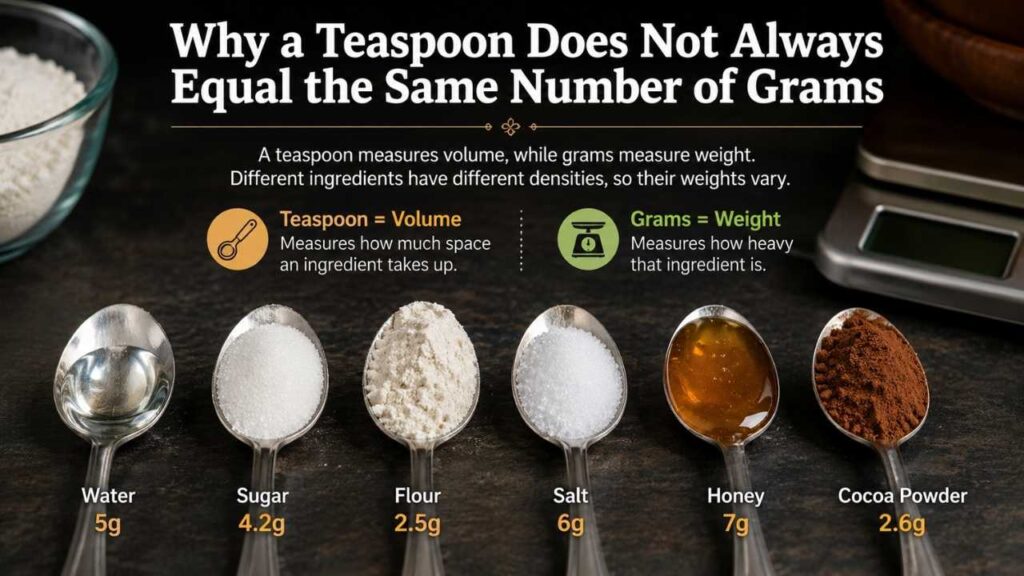
Many people assume that one teaspoon always equals the same number of grams, but that is not true. A teaspoon measures volume, while grams measure weight. The relationship between the two depends on the density of the ingredient. Density refers to how much matter is packed into a specific amount of space. Heavy ingredients weigh more, while lighter ingredients weigh less, even when they fill the same teaspoon.
For example, a teaspoon of honey contains more weight than a teaspoon of flour because honey is denser. This explains why teaspoon to grams conversion varies across ingredients. Understanding density is important when using cooking measurements and baking measurements. Accurate conversions help you avoid recipe mistakes and produce consistent results. This is also why professional bakers prefer measuring ingredients by weight rather than volume whenever possible.
Teaspoon to Grams Conversion Table for Common Ingredients
A reliable ingredient conversion chart helps you convert teaspoons into grams quickly and accurately. Since every ingredient has a unique density, using a conversion table is much more effective than guessing. Below are some common kitchen conversions:
- Water – 5g
- White Sugar – 4.2g
- Brown Sugar – 4.5g
- Flour – 2.5g
- Salt – 5–6g
- Honey – 7g
- Butter – 4.7g
- Baking Powder – 4g
- Baking Soda – 4.8g
- Cocoa Powder – 2.6g
- Cornstarch – 2.7g
- Milk – 5.1g
- Vegetable Oil – 4.5g
- Dry Yeast – 3g
These values serve as useful estimates for everyday cooking. If accuracy matters, especially in baking, use a kitchen scale alongside a grams conversion table. This method provides more precise results and improves recipe consistency.
How to Convert Teaspoons to Grams
Learning how to convert teaspoons to grams can make cooking and baking much easier. Since teaspoons measure volume and grams measure weight, you need to know the ingredient’s density before making the conversion. The basic formula is:
Grams = Teaspoons × Ingredient Density
For example, if one teaspoon of sugar weighs about 4.2 grams, then two teaspoons of sugar equal approximately 8.4 grams. Likewise, if one teaspoon of flour weighs around 2.5 grams, four teaspoons equal about 10 grams.
This simple formula works for both dry and liquid ingredients. However, the density value changes from ingredient to ingredient. That is why professional chefs often rely on a teaspoon to grams conversion chart instead of memorizing individual values. Using the correct conversion improves measurement accuracy and helps you create more consistent recipes every time.
How to Convert Grams to Teaspoons
Sometimes a recipe lists ingredients in grams while your measuring tools use teaspoons. In this situation, you need to convert grams back into teaspoons. The formula is straightforward:
Teaspoons = Grams ÷ Ingredient Density
For example, if sugar has a density equivalent of 4.2 grams per teaspoon, then 8.4 grams of sugar equals 2 teaspoons. If flour weighs approximately 2.5 grams per teaspoon, then 10 grams of flour equals about 4 teaspoons.
This reverse calculation is especially useful when following international recipes that use metric measurements. It also helps when scaling recipes up or down. Remember that ingredient density always affects the result, so never use the same conversion for every ingredient. Referring to a reliable grams to teaspoons chart or conversion table ensures greater accuracy and reduces the risk of measurement errors.
Teaspoon to Gram Conversion Examples
Real-world examples make teaspoon to grams conversion easier to understand. Suppose a recipe requires three teaspoons of sugar. Since one teaspoon of sugar weighs approximately 4.2 grams, three teaspoons equal about 12.6 grams. If a recipe calls for four teaspoons of flour, you can multiply 4 by 2.5 grams, giving you roughly 10 grams.
For salt, one teaspoon generally weighs between 5 and 6 grams, depending on the type of salt. A teaspoon of honey weighs around 7 grams because it has a higher density. These examples show why ingredient-specific conversions matter. Using the wrong conversion can change the texture, taste, and quality of a recipe. By following a trusted ingredient conversion chart, you can achieve more accurate measurements and better cooking results every time.
Teaspoon vs Tablespoon vs Grams
Understanding the difference between teaspoons, tablespoons, and grams helps prevent measurement mistakes. A teaspoon and tablespoon both measure volume, while grams measure weight. In most measurement systems, one tablespoon equals three teaspoons. However, converting tablespoons or teaspoons directly into grams requires knowledge of the ingredient’s density.
For example, one tablespoon of sugar weighs more than one tablespoon of flour because sugar is denser. Many recipe errors occur when people assume all ingredients weigh the same. Grams provide a more accurate way to measure ingredients because they eliminate variations caused by packing, scooping, or leveling. This is why professional bakers often rely on digital scales instead of measuring spoons. Understanding these differences helps you follow recipes more accurately and improves consistency in both cooking and baking projects.
Level Teaspoon vs Heaped Teaspoon
The way you fill a teaspoon can significantly affect the weight of an ingredient. A level teaspoon contains ingredient even with the top edge of the spoon. A heaped teaspoon contains extra ingredient piled above the rim. Because of this difference, a heaped teaspoon often weighs much more than a level teaspoon.
For example, a level teaspoon of flour weighs less than a heaped teaspoon of flour. The same principle applies to sugar, cocoa powder, baking powder, and many other dry ingredients. This variation can cause measurement errors, especially in baking where precise ratios matter. When a recipe specifies teaspoons, most authors assume a level teaspoon unless stated otherwise. Using consistent measuring methods helps improve recipe accuracy and reduces unexpected results. A simple leveling technique can make your cooking measurements far more reliable and predictable.
Why Professional Bakers Prefer Grams
Professional bakers almost always measure ingredients in grams rather than teaspoons or cups. The main reason is accuracy. Weight-based measurements remain consistent regardless of how an ingredient is scooped, packed, or leveled. Volume measurements can vary from person to person, leading to inconsistent results.
For example, two people can measure flour differently using the same teaspoon. One may pack the flour tightly, while another may scoop it lightly. This difference changes the amount of flour in the recipe. Grams eliminate that problem completely. Professional kitchens use digital scales because they provide precise measurements and improve consistency. Whether you are making bread, cakes, or pastries, measuring by weight helps produce repeatable results. If you want more reliable baking outcomes, switching from volume measurements to grams is one of the simplest improvements you can make.
Common Ingredient Density Chart
An ingredient density chart helps explain why different ingredients have different weights even when measured with the same teaspoon. Dense ingredients contain more mass in a small space, while lighter ingredients contain less mass. This directly affects teaspoon to grams conversion.
For example, honey is much denser than flour, which is why a teaspoon of honey weighs more. Sugar, salt, butter, and cocoa powder all have different densities as well. Understanding these differences allows you to make more accurate recipe conversions and avoid common mistakes. Density charts are especially useful when converting between metric and standard measurements. They also help when scaling recipes for larger or smaller servings. Instead of relying on assumptions, use an ingredient density chart to determine the correct weight for each ingredient. This approach improves precision and creates more consistent cooking results.
Kitchen Tools That Improve Measurement Accuracy
Using the right tools can dramatically improve measurement accuracy in the kitchen. Measuring spoons work well for small quantities, but a digital kitchen scale provides much greater precision. Scales measure ingredients directly in grams, eliminating guesswork and reducing conversion errors.
A set of standardized measuring spoons also helps maintain consistency. Make sure you level dry ingredients properly and avoid packing ingredients unless a recipe specifically instructs you to do so. For liquids, use appropriate measuring tools to ensure accurate volume readings. Many home cooks also use online conversion charts and kitchen measurement guides to double-check calculations. Combining these tools with a reliable teaspoon to grams conversion table helps improve recipe accuracy. Whether you are cooking a simple meal or baking a complex dessert, precise measurements contribute to better flavor, texture, and overall success.
Frequently Asked Questions
Is 1 teaspoon equal to 5 grams?
Not always. Water equals about 5 grams per teaspoon, but other ingredients vary depending on density.
How many grams is 1 teaspoon of sugar?
One teaspoon of sugar weighs approximately 4.2 grams.
How many grams is 1 teaspoon of flour?
One teaspoon of flour weighs around 2.5 grams.
How many grams is 1 teaspoon of salt?
Most salts weigh between 5 and 6 grams per teaspoon.
How many teaspoons are in 10 grams?
The answer depends on the ingredient. For sugar, 10 grams equals roughly 2.4 teaspoons.
Why do teaspoon conversions vary?
Different ingredients have different densities, which affects their weight.
Is measuring in grams more accurate?
Yes. Grams provide more consistent and precise measurements than teaspoons.
Can I use the same conversion for every ingredient?
No. Each ingredient requires its own conversion value.
Conclusion
Understanding how many grams in a teaspoon is essential for accurate cooking and baking. Since teaspoons measure volume and grams measure weight, the conversion changes based on the ingredient’s density. A teaspoon of sugar, flour, salt, or honey will not weigh the same amount. Using a trusted teaspoon to grams conversion chart helps eliminate confusion and improves recipe consistency.
Whether you are converting sugar, flour, baking powder, or other ingredients, always use ingredient-specific values for the best results. For maximum accuracy, combine conversion charts with a digital kitchen scale. This simple approach helps you create better recipes, reduce measurement errors, and achieve more consistent outcomes every time you cook or bake.