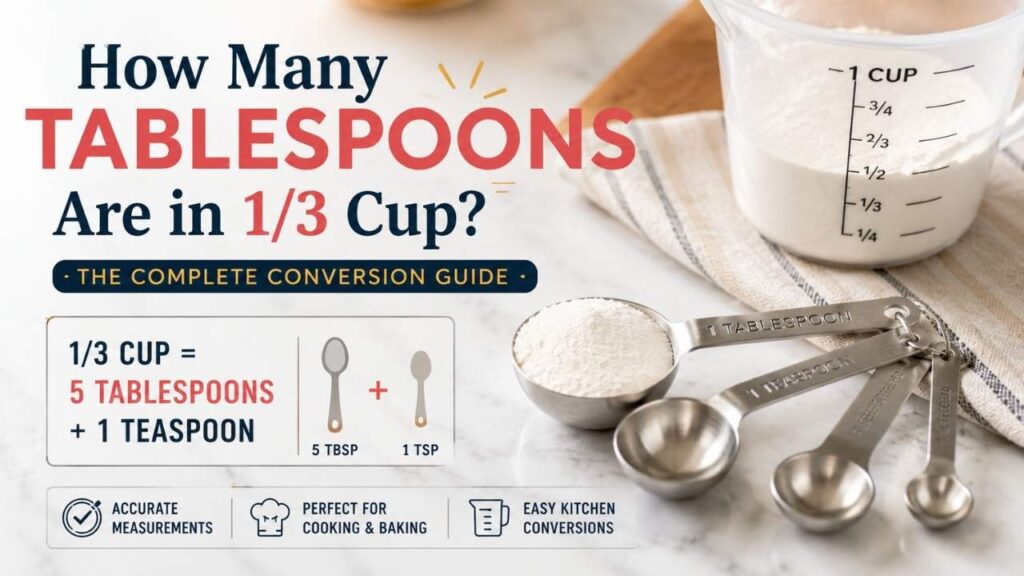

If you have ever followed a recipe and wondered how many tablespoons in 1/3 cup, you are not alone. Many home cooks and bakers need quick cooking measurements and baking measurements when they do not have the right measuring tools nearby. Understanding 1/3 cup to tablespoons conversions can help you prepare recipes accurately and avoid mistakes that affect the final result.
The simple answer is that 1/3 cup equals 5 tablespoons plus 1 teaspoon, or approximately 5⅓ tablespoons. This conversion is useful when you need a quick substitute for a measuring cup or when you want to scale a recipe up or down.
Knowing how to convert cups to tablespoons also helps you work confidently with different recipes, ingredient amounts, and kitchen conversion charts. In this guide, you’ll learn everything you need to know about tablespoons in 1/3 cup, along with practical measuring tips and useful conversion references.
Quick Answer
If you are wondering how many tablespoons are in 1/3 cup, the answer is simple. 1/3 cup equals 5 tablespoons plus 1 teaspoon, which is the same as 5⅓ tablespoons. This cup-to-tablespoon conversion helps when you do not have a 1/3 cup measuring tool available. Whether you are baking cookies, making sauces, or following a recipe, knowing this kitchen measurement conversion can save time and improve accuracy.
1/3 Cup to Tablespoons Conversion
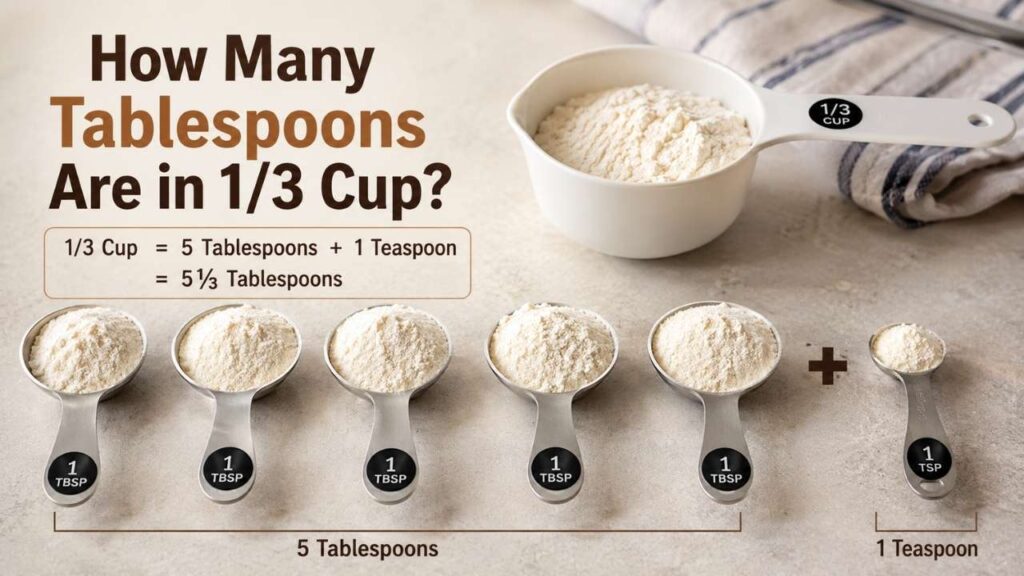
Understanding a 1/3 cup to tablespoons conversion makes cooking and baking much easier. In the U.S. measurement system, 1 cup equals 16 tablespoons. When you divide 16 by 3, you get approximately 5.33 tablespoons, which translates to 5 tablespoons and 1 teaspoon. This is the most accurate way to measure 1/3 cup in tablespoons.
Many recipes use cups while others use tablespoons, so learning this cooking measurement conversion can help you switch between measurements without confusion. Whether you are preparing dry ingredients like flour or liquid ingredients such as milk, accurate measurements help create consistent results.
A reliable kitchen conversion chart is always useful, but remembering that 1/3 cup equals 5 tablespoons plus 1 teaspoon can save time when you are cooking. This simple conversion is one of the most commonly used measurements in both everyday cooking and baking.
Why Does 1/3 Cup Equal 5⅓ Tablespoons?
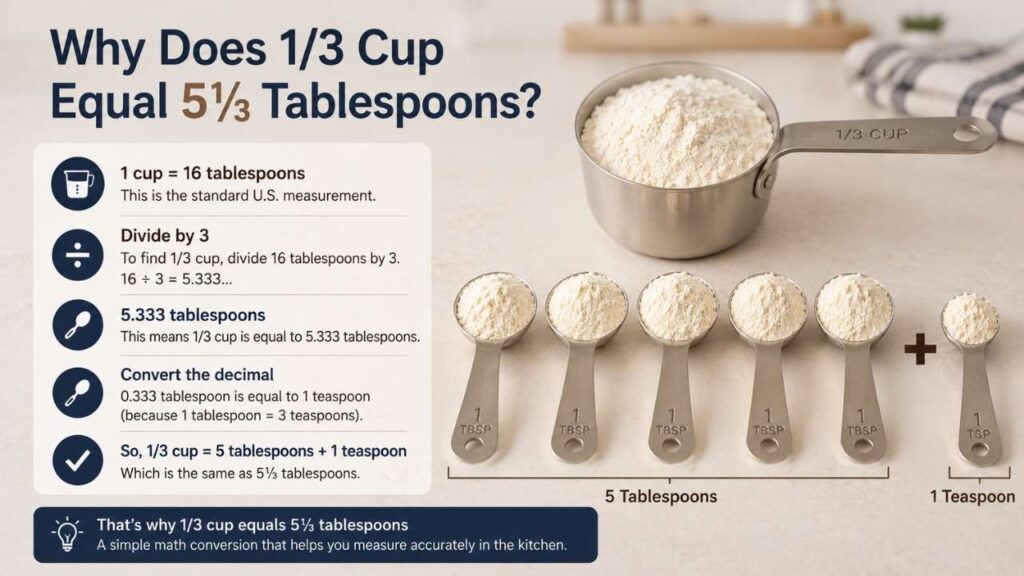
Many people want to know why 1/3 cup equals 5⅓ tablespoons instead of a whole number. The answer comes from the standard U.S. measurement system. Since 1 cup contains 16 tablespoons, dividing that amount by three gives 5.333 tablespoons. Because measuring one-third of a tablespoon is difficult, cooks usually convert the remaining fraction into teaspoons.
Since 1 tablespoon equals 3 teaspoons, one-third of a tablespoon equals 1 teaspoon. That is why most recipes and baking measurement guides state that 1/3 cup equals 5 tablespoons plus 1 teaspoon. Understanding this calculation helps when you need to scale recipes or perform other measurement conversions. It also allows you to convert cups to tablespoons accurately without relying on online calculators. Once you understand the formula, converting other cup measurements becomes much easier.
How to Measure 1/3 Cup Without a Measuring Cup
Sometimes you may need 1/3 cup, but you do not have a measuring cup available. Fortunately, you can still measure the correct amount using standard measuring spoons. Simply use 5 tablespoons plus 1 teaspoon to create an accurate 1/3 cup substitute.
This method works well for both dry and liquid ingredients. For dry ingredients such as sugar or flour, level off each spoon with a flat edge for better accuracy. For liquids, fill each spoon carefully to avoid spills. Many home cooks use this method when they need quick recipe measurement conversions without purchasing additional tools.
Learning how to measure 1/3 cup using tablespoons is a practical kitchen skill that can save time. It also helps when recipes call for unusual measurements. Whether you are baking cakes, preparing sauces, or cooking dinner, this simple technique ensures consistent and reliable results.
Common Cup-to-Tablespoon Conversions
A good cup-to-tablespoon conversion chart makes cooking much easier. Instead of searching for measurements every time you cook, you can use these common conversions as a quick reference.
- 1/8 cup = 2 tablespoons
- 1/4 cup = 4 tablespoons
- 1/3 cup = 5⅓ tablespoons
- 1/2 cup = 8 tablespoons
- 2/3 cup = 10⅔ tablespoons
- 3/4 cup = 12 tablespoons
- 1 cup = 16 tablespoons
These conversions are useful for recipe measurements, ingredient substitutions, and portion adjustments. Many baking recipes require precise measurements, so understanding these values can help prevent mistakes. Keeping a kitchen conversion chart nearby can also speed up meal preparation. Whether you are doubling a recipe or reducing serving sizes, these common tablespoon conversions provide a simple and effective way to measure ingredients accurately.
1/3 Cup in Other Measurements
Knowing 1/3 cup in other measurements can be helpful when a recipe uses different units. Besides being equal to 5 tablespoons plus 1 teaspoon, 1/3 cup converts into several other common measurements.
- 1/3 cup = 16 teaspoons
- 1/3 cup = 5⅓ tablespoons
- 1/3 cup = 2.67 fluid ounces
- 1/3 cup = approximately 79 milliliters
These conversions are useful when following international recipes or using metric measuring tools. Many recipes list ingredients in milliliters, while others use fluid ounces. Understanding these equivalents allows you to adapt recipes more easily. However, when converting 1/3 cup into grams, the weight depends on the ingredient. Flour, sugar, butter, and water all have different weights. For the most accurate results, use a kitchen scale whenever possible. This approach helps improve consistency in baking and cooking.
US vs Metric Tablespoon Measurements
Not all tablespoons are exactly the same around the world. In the United States, one tablespoon equals approximately 14.8 milliliters. However, some countries use slightly different standards. For example, an Australian tablespoon equals 20 milliliters, which is larger than a U.S. tablespoon.
These differences may seem small, but they can affect recipes, especially in baking. When you use a recipe from another country, it is important to understand the measurement system being used. This is why many professional cooks pay close attention to metric measurements, imperial measurements, and U.S. customary measurements.
If a recipe specifically mentions Australian measurements, use the appropriate conversion to maintain accuracy. Understanding these international differences helps you avoid common mistakes and ensures your recipes turn out as intended.
Common Baking Mistakes When Measuring 1/3 Cup
Even a simple measurement like 1/3 cup can cause problems if it is measured incorrectly. One common mistake is using rounded measurements instead of the exact amount. Some people use only 5 tablespoons, but the correct conversion is 5 tablespoons plus 1 teaspoon.
Another mistake occurs when measuring flour or brown sugar. Packing ingredients too tightly can change the quantity and affect the recipe. Using the wrong measuring tools can also create inconsistencies. Dry measuring cups work best for dry ingredients, while liquid measuring cups are better for liquids.
Many baking failures happen because of inaccurate ingredient measurements rather than poor recipes. Taking a few extra seconds to measure properly can improve texture, flavor, and appearance. Accurate baking measurements help ensure reliable and repeatable results every time you cook.
When Accurate Measurement Matters Most
Accurate measurements are important in every recipe, but they matter even more in baking. Cakes, breads, muffins, and pastries rely on precise ingredient ratios. Even a small measuring error can affect texture, moisture, and structure.
For example, using too much flour can make baked goods dry and dense. Using too little liquid may prevent dough from developing properly. This is why professional bakers pay close attention to cooking measurements, baking measurements, and ingredient quantities.
Accurate measuring is also important when preparing sauces, dressings, and marinades. Consistent measurements help maintain the intended flavor balance. Whether you are following a simple recipe or an advanced baking project, understanding how many tablespoons are in 1/3 cup helps you achieve better results. Small measurement adjustments often make a significant difference in the final dish.
Quick Kitchen Conversion Chart
A kitchen conversion chart can make everyday cooking much easier. Instead of searching for measurements repeatedly, you can use a simple reference guide.
| Cups | Tablespoons |
| 1/8 Cup | 2 Tbsp |
| 1/4 Cup | 4 Tbsp |
| 1/3 Cup | 5⅓ Tbsp |
| 1/2 Cup | 8 Tbsp |
| 2/3 Cup | 10⅔ Tbsp |
| 3/4 Cup | 12 Tbsp |
| 1 Cup | 16 Tbsp |
This chart is especially helpful when adjusting serving sizes or converting ingredients. Many cooks keep similar references in their kitchens because they simplify recipe conversions and reduce measuring errors. Whether you are baking desserts or preparing everyday meals, these common cup-to-tablespoon conversions provide a quick and reliable solution.
FAQs
Is 1/3 cup exactly 5 tablespoons?
No. 1/3 cup equals 5 tablespoons plus 1 teaspoon, not exactly 5 tablespoons. Using the extra teaspoon provides a more accurate measurement.
How many tablespoons and teaspoons are in 1/3 cup?
There are 5 tablespoons and 1 teaspoon in 1/3 cup.
Can I use 5 tablespoons instead of 1/3 cup?
You can, but it will be slightly less than the correct amount. For the best results, add 1 teaspoon.
How much is 1/3 cup in milliliters?
1/3 cup equals approximately 79 milliliters.
What is 2/3 cup in tablespoons?
2/3 cup equals 10 tablespoons plus 2 teaspoons, or approximately 10⅔ tablespoons.
How do I measure 1/3 cup without measuring tools?
Use 5 tablespoons plus 1 teaspoon for an accurate substitute.
Is a tablespoon the same worldwide?
No. Different countries use slightly different tablespoon measurements, so always check the recipe source.
Conclusion
Knowing how many tablespoons are in 1/3 cup can make cooking and baking much easier. The correct conversion is 5 tablespoons plus 1 teaspoon, or approximately 5⅓ tablespoons. This simple measurement helps when you need a quick substitute, scale recipes, or follow a kitchen conversion chart.
By understanding common cup-to-tablespoon conversions, using accurate measuring techniques, and recognizing international measurement differences, you can prepare recipes with greater confidence and consistency.